This week has seen a big change in direction for the project : The first half of this post is the new project and the final slide presentation. The work at the end of the blog is the previous work I’d done in the lead up to my project change.
Following feedback on the Ideas Wall for my work below, I’ve decided to rethink the direction of my project. The idea about looking into vitual post it notes etc has been covered before and I think, considering what was mentioned on the wall, it’s been successful before and this just would hinder my progress to try and redo an already successful project.
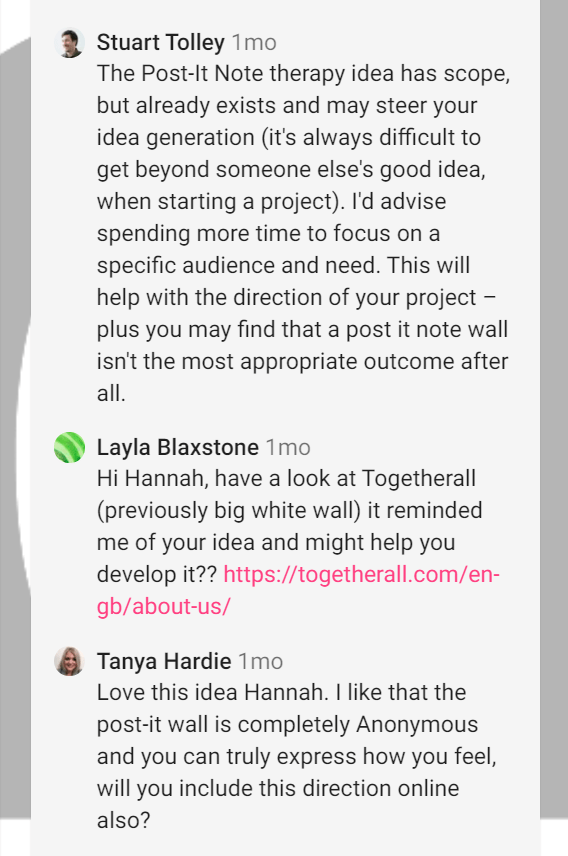
It’s really interesting that Tanya mentioned the anonymous section as this is the area I felt was strongest – however upon researching into this more, as good as being honest and anonymous, it can have steep repercussions with regards to severe mental health issues and not being able to contact someone who may be in trouble. Or it could encourage people to post negative comments under the guise that no one knows who they are. It’s a bit of a minefield and I just don’t think it’s going to fit into a successful project.
Personally, I believe I should follow routes that I know work – I’ve been training in Social and Theraputic Horticulture and, after planting some of my own seeds recently, it’d be good to get back to basics and have a think about a successful mental health / wellbeing project.
I have recently been reading up on the benefits of STH – and came across an American Journal specifically researching the benefits of TH.
The restorative effects of the garden reported here are thus congruent with the dominant paradigm that adderts that contact with nature is psychologically beneficial”.
Harris, H. (2017)
I’ve also been rethinking the work I did below and the depth of knowledge I had. Community, solidarity and something to take your mind off problems is the first step to overcoming mental health issues. I need to keep hold of this and keep these three pillars as the main foundation to the project.
Voice-over:
Chosen Brief: I have chosen the Creative Conscience brief – of all the briefs this one really stood out to me with the scope and potential to really learn about mental health and the stigmas that still exist. I also have some experience in strategies to overcoming mental health issues such as anxiety, stress or depression. To combine this knowledge with the research into the recent pandemic, I hope to create a successful and positive project.
Research: My research into this topic has been broad so far, and has highlighted the negative effect the pandemic has had on young adults aged 18-24. This age group have reported worsening mental health states. I intend to interview a number of people within this age bracket and utilise my contacts within the hospital industry to see how they feel about existing options for young adults with regards to improving mental health.
Project Plan and Development: Utilising my personal understanding of how taking part in some gardening can vastly improve mental health will be a big part to this project. It needs to be something that encourages young adults to get involved with being green fingered and teaches them how to nuture and look after something. This also takes someone away from Social Media which can often be the main cause of mental health related issues. I need to consider how young adults with no outdoor space or previous knowledge of plants can get involved. It also needs to be appropriate for the age range and consider that people might not want to get involved in group activities given the current circumstances.
Audience: it’s a very broad age range but it covers new University students, graduates in their first job, people employed in jobs within an uncertain sector eg retail (closed for many months). This unprecedented pandemic is set to continue and the lockdowns don’t have an end in sight. Although this age range is broad, it covers all of Gen Z, commonly known as the Green Generation – they are extremely concious about sustainability, the enviroment and, surprisingly, during the lockdown, have taken on more responsibilities in the form of houseplants!
Goals: At present, my intention is to create a form of new green community, to involve young adults who are not experienced in gardening, supply them with an easy path to start growing their own plants from scratch. There’s a big problem with people buying ready grown houseplants, mroe often than not they only look good for a certain amount of time and with the wrong care and no feeding, the plants wither. It’d be a form of education as well as a community to share problems and find solidarity within this new community. Currently I’m consider a subscription box with seeds or perhaps a website selling certain strange, fun and easy to grow seeds that keep people interested. I will also be looking into creating a supporting app, the current apps for mental health are extensive but often very medical, the apps for plants are mainly for buying or caring for plants, or even watering a plant animation.
Video:
Follow this link to view my video presentation for this project’s strategy.
Brief Question
“How can Graphic Design be utilised to encourage young adults to improve their mental health by learning to grow and care for plants?”
Previous work and research for the project:
My intention is to utilise the research from the previous blog to start to understand the focus of this project. I’m also intending on researching methods of community therapy and solidarity through anonymity to define the outcome.
I have a set of interveiw questions for both the general public (family/friends/colleagues) and also for Mental Health Practitioners and Specialists at York Hospital as I have contacts there:
- FAMILY/FRIENDS:
- Have you personally been affected by the Pandemic and, if you don’t mind saying, how?
- Have you struggled to come to terms with personal problems more this year?
- Do you have a usual outlet for offloading when you have a problem or issue? Has this been affected by the pandemic?
- What has helped give you perspective on this year and your own problems?
- Do you think you could have benefitted from an anonymous outlet to offload problems?
- SPECIALISTS:
- How do you believe the pandemic has affected mental health directly?
- Have you noticed a change in the way people are dealing with their problems?
- Do you have any recommendations for how people could offload problems they have?
- During your time through the pandemic, have you, personally, been affected?
- When speaking to patients, have you struggled to achieve the same results when video calling as you would have face-to-face and why?
- Do you believe this new format of online consultations will remain?
My intention is to speak to as many people as possible either face to face or online (in line with current restrictions obvs). I also really need to nail down my audience – my research has shown there is a big divide between 18-24year olds and 24+ adults. I think this will be my starting point, but as I’m intending on launching an online platform, it’d be remiss of me to narrow down the audience to such an extent, others aren’t able to use it or aren’t attracted to it.
My focus with this project is to utilise Post-It Note Therapy (something I’ve researched before and love the idea of). This has been used on Subway stations across America previously as a form of anonymous therapy via offloading and providing support and solidarity to others. This grew in popularity and it provided some really powerful responses (post-it notes have a small space to write in so result in more powerful words being used). It would be my intention, somehow, to create a website and app providing the same ability to anonymously offload and provide support for others. It’s all about providing support, positivity and the ability to get out your deepest darkest worries without being concerned about people knowing who you are.
Reflection
This week was a turning point for this project and I feel much happier with the new direction. I think initially I was taking on too much for the brief and not narrowing down my research and planning sufficiently. As per the previous brief, I have had a change of direction – I do not see this as a bad thing by any means, it’s really positive that I am more focussed on the strategies and projection of the work.
However, I can’t be changing my direction in every project I do and I need to look back at what went wrong in both briefs to make my projects dramatically change at this stage. Looking at both briefs, I chose such large and open ideas and didn’t spend the time narrowing down and really clarifying the exact idea. This resulted in a vague, muddy and pretty huge idea and plan. By not considering timescales, availability and clarity, I failed at the first hurdle.
I’m not going to be afraid of failure though, sometimes you need it to gain that motivation that was previously missing.
My next step will be working on really clearing up my vision for this project and focussing on the strategy I have in place. By pushing myself to really gain that vision, I know my project will be much clearer and will result in a more coherent piece.
I will also be working on speaking to the target audience and really getting to grips with their thoughts on the idea. I will be speaking to volunteers at York Design Week as they will predominantely be in my target age range.
Bibliography
Harris, H., 2017. ‘The social dimensions of theraputic horticulture’, Health & Social Care in the community, vol. 25, no. 4, pp. 1328-1336.
 Hannah Elizabeth Design